






Usually when I’m discussing core concepts, I try to be gender-neutral. It is true that horse kids of all ages also come in all genders. But a particular subspecies has surfaced lately in both fact and fiction, and that’s the horse girl. The female-presenting person who lives and breathes horses. Who is most alive and most truly herself in symbiosis with equines.
She’s always out there. I am one, and so are many of my friends and colleagues. Anne McCaffrey used to talk about the SFWA Cavalry, because so many SF and F writers were horse people. That’s still true.
When Queen Elizabeth II of Great Britain died after a long and full life, one of the things that defined her was her love of animals—specifically dogs and horses. Her identity and her history were complicated and she aroused strong negative emotions as well as positive ones. But there was never any question that when she was at home, she was very much about the horses. They were her happy place.
She was a bit of a hero to the horse girls of the world. Not just that she was so devoted to horses all her life, or that her daughter Princess Anne has carried on her footsteps (hoofprints? Stirrups?), but that she was riding almost to the very end. Whenever she could, she would slip away to be with the horses.
As she grew older, she did make one concession. She moved away from the larger horses to a smaller, very sturdy, native breed, the Fell pony. She was a great patron of the breed, and she delighted in showing them off. News reports and social media delighted in turn in publishing pictures of her riding one of her ponies.
That’s dedication, to still be riding in your nineties. It’s the epitome of the Horse Girl. She was lucky that she stayed fit enough, still had the balance and the core strength. But true horse girls may find other ways to express their passion if riding is out of the question. Driving. Breeding, with staff to raise and train the foals. Judging and managing horse shows. Or simply being with horses whenever they can—up to and including therapy horses that visit care homes and hospices.
After the Queen died, one of the most poignant images that emerged from her funeral was a green lawn at Windsor. On it, as the cortege rolled past, was an elderly man in riding attire, and a black pony. The pony was saddled and bridled. Draped over her saddle, wrapped under the stirrups, was a silk scarf.
The man was her groom, and she wore the scarf when she rode with him. The mare’s name was Emma.
I don’t know what Emma felt, or if she knew that her person was gone. I suspect she did. Horses know a great deal.
She’s still at Windsor, being loved and cared for. The groom, I believe, has retired. Emma, from what I’ve heard, will live out her life in her familiar stable.
To a horse girl, this is vital information. Far too many people use horses as sports equipment or money machines. Horse girls live and breathe their horses. If at all possible, the keep their horses for life, or at the very least, make sure they’re well and safely cared for in their old age. It matters that Emma will be all right.
Right around the time we were saying goodbye to a Queen of horse girls, fantasy fans were treated to a surprising entry in the annals of fictional horse girls. The Lord of the Rings prequel series, The Rings of Power, is a whole huge basket of Easter eggs and fan service. What we didn’t expect was that one of the central figures of the legendarium, Galadriel, would turn out to be a horse girl.
Tolkien was not what I consider a horseman. He didn’t own horses and I don’t know that he ever had much to do with them. However they were very much a part of his world.
They were not only transport. They had names and histories. Everyone remembers Shadowfax, the king of horses who would only ever allow Gandalf on his back, but the books and stories are full of horses and ponies, from Bill the Pony to Aragorn’s horse Roheryn to the elf-horse Asfaloth. And let’s not forget Shadowfax’s whole breed, the Mearas of Rohan.
There’s a basis, then, for making horses a key part of the new series. There’s even some support for the idea that Elves could be horse people. Though the idea that Numenor was big on horse breeding—well, it’s definitely not in canon, but some things we have to just sit back and let happen.
So here we were in Numenor, with Plot Stuff going on, and Galadriel interacting with one of the greats of the future world, a sea captain named Elendil. For Plot Reasons, they need to get to the other side of the island kingdom. Half a day’s ride, he says.
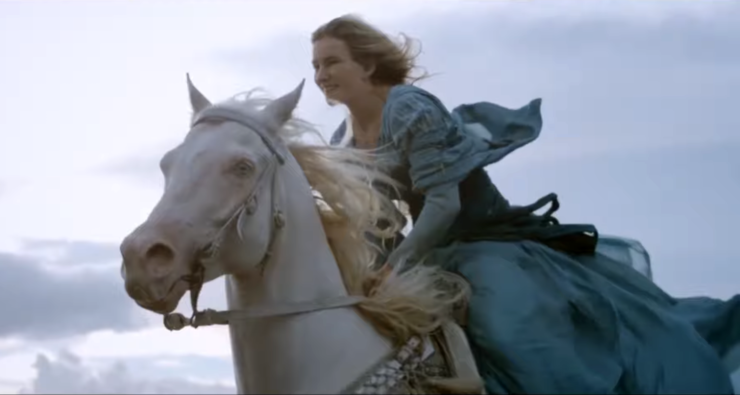
Galadriel’s eyes light up. Not just with the light that shines in Elvish eyes—terrible Elves with their bright eyes, Gollum will say, a few thousand years later. No, this is a different light altogether, a light horse girls know better than any. “Ride?” she says.
Reviewers grumbled about “beauty shots” and pacing and Oh Come On and Bored Now. Horse girls had no such objections. We knew exactly what she was feeling when she galloped across those beaches on that amazing goldy-pink horse.
Who knew Galadriel of all people would turn out to be one of us? In the books she’s mostly about woods and starlight and secret magic. When Frodo offers her the Ring, she has a Moment, but she resists the temptation. She gives gifts and sings sad songs and serves as a kind of eminence grise, a shadowy figure who does great deeds far offstage.
There’s nothing in there about horses. One facebook commenter offered a lovely bit of head canon, an image of a hidden stable of horses in Lothlorien. Galadriel, like Queen Elizabeth, might have found a refuge there, a place to escape from her duties and obligations.
Head canon for horse girls always has horses in the middle. As far as actual show canon goes, Galadriel as horse girl is a gift to all the horse girls in fandom. We’ve loved Shadowfax, we’ve doted on Bill the Pony, we’ve dreamed of racing Black Riders on Asfaloth. Now we have Galadriel on her uniquely colored horse with his eerie blue eyes.
That’s not everything we’re given, either. Peter Jackson’s LOTR films gave us a different horse for Aragorn than the ones in the books: a big bay named Brego. Rings of Power replicates him in Isildur’s bay life-partner, Berek.
What makes this extra special is that Elendil, though he’s primarily a sea captain, is also, in his way, a horse girl. He understands about the bond between horse and rider, and teaches some of it to his son.
As for where he learned it, it seems his late wife was a horse girl. A trainer, probably. Maybe a breeder, who knows. What matters is that she knew horses and loved them, and she passed that knowledge to her husband. Clearly her son inherited her love of horses.
I have a multitude of issues with the writing of this series, but I love that horses play an important part in it. Making Galadriel a horse girl is the first sign we get that she’s more than a revenge-driven killing machine. It’s a side of her that may not be in canon, but it softens the edges. It hints that she may have an inclination toward peace and calm and the kind of deep empathy that humans share with their horses.
It’s a promise of sorts. An indication that she really is going to mature into one of the Wise.
Judith Tarr is a lifelong horse person. She supports her habit by writing works of fantasy and science fiction as well as historical novels, many of which have been published as ebooks. She’s written a primer for writers who want to write about horses: Writing Horses: The Fine Art of Getting It Right. She lives near Tucson, Arizona with a herd of Lipizzans, a clowder of cats, and a blue-eyed dog.


I respectfully submit that a horse girl’s spear counterpart should be a “pony boy” but otherwise endorse this article (Also, if you’re looking for a hint of Pony Girl in the original Lady Galadriel, consider that as Eorl the Young & his riders skirted Lothlorien on their way to the Field of Celebrant the horses of the Eotheod appear to have received some sort of boost: hardly conclusive proof, but a little amusing in the light of RINGS OF POWER).
Thank you, Judith. Your description—more than any other defense of RoPer Galadriel—has deepened my appreciation for this character portrayal.
Yup, QE2 was a horse girl, as shown by her relaxed body language and easy contact with horses. Never afraid to approach and interact with them.
And Princess Anne took it further, riding competitively on the British Olympic team. Watching her compete many years ago, I saw her and her horse fall at a fence on a cross-country ride. She sprang up, caught her horse, remounted and finished, with blood streaming down her face from a cut on her mouth. Tough girl …
House of the Dragon had cold open to Episode 5 with a very appealing horse girl – Rhea Royce, Lady of Runestone in the Vale. Can’t discuss further because of spoilers.
@1 Ooooo! That re. the Eotheod is relevant to my interests.
@2 You’re welcome. I think there will be more to her as the series goes on, but that one scene struck me as a real insight into who she is underneath.
@3 I recently saw photos of Anne riding a stallion in Vienna, and HM rode one of Podhajsky’s horses when the Spanish Riding School was in England. Both of them would have appreciated the experience very much.
@@.-@ Oh yes, I noticed her horse. He was lovely.
I’m mildly startled at the concept of “horse girls” having “surfaced lately”, as to me, you are always with us, but I see what you mean. To me it doesn’t say Dernhelm but Norman Thelwell, a twentieth century cartoon artist of the English countryside who rarely drew a horse or pony without a huntswoman or a small child either on the animal or recently thrown off. In the rules of the road there’s a chapter for horses, if they can read; C. S. Lewis had ’em talk, so why not. And Terry Pratchett’s Lady Sibyl Ramkin has stables, but for dragons… very small ones. Nevertheless the atmosphere is the same as when horses are accommodated, but occasionally a lot warmer.
It wasn’t just writers who were riders; back in the early days of the New England Science Fiction Association, a number of women declared the NESFA Cavalry. (There were also noises about a Men’s Auxiliary, although this was most visibly someone who had grown up on a cattle ranch in South Dakota and had a rather different slant on horses.) (Someone who was not a rider moved that the official mount be the quagga, which was suitably fantastic (being extinct), but probably not ridable as it was related to the zebra, IIUC a notoriously unridable animal.) When Ann Layman Chancellor did sketches of various NESFA “uniforms” (Electrician, Feline Deity, …) she included dress and undress garb for the Cavalry; they’re still somewhere around the NESFA clubhouse — probably not hung any more because the walls have been covered with bookshelves.
Numenoreans were well acquainted with horses and horse breeding, in the canon:
“In Númenor all journeyed from place to place on horseback; for in riding the Númenóreans, both men and women, took delight, and all the people of the land loved horses, treating them honourably and housing them nobly. They were trained to hear and answer calls from a great distance, and it is said in old tales that where there was great love between men and women and their favourite steeds they could be summoned at need by thought alone.”
Unfinished Tales, Description of the Island of Numenor
However, and where the showrunners screw up, on the use of horses in warfare:
“The Númenóreans in their own land possessed horses, which they esteemed. But they did not use them in war; for all their wars were overseas. Also they were of great stature and strength, and their fully-equipped soldiers were accustomed to bear heavy armour and weapons. In their settlements on the shores of Middle-earth they acquired and bred horses, but used them little for riding, except in sport and pleasure. In war they were used only by couriers, and by bodies of light-armed archers (often not of Númenórean race).”
UT, Disaster of the Gladden Fields
Regarding pony-boys, I suggest you look at a YA urban fantasy book from the 60s, Zilpha Keatley Snyder’s Season of Ponies. The main character is a horse-loving girl who meets a rather Peter-Pan-esque pony boy, naturally called Pony, who lives with a herd of rainbow colored ponies in the forest. She discovers she has a knack for riding, and has adventures with the ponies and the boy before Pony and his herd ride off into the sunset.
Picture books, you could do worse than the Native American fable by Paul Goble, The Girl Who Loved Wild Horses.
“Tolkien was not what I consider a horseman. He didn’t own horses and I don’t know that he ever had much to do with them. However they were very much a part of his world.”
Tolkien was in King Edward’s Horse cavalry regiment as an undergraduate. This is before he enlisted. I know we have little information about this part of his life, other than what John Garth has in his book, but I think he never forgot his brief time in that service.
@6 I should have been clearer. I have lately been seeing multiple references to horse girls, many in connection with Galadriel and Queen Elizabeth. This is not about how long the concept has existed, but about how it has shown up more than usually often of late.
@8 What fun!
@9 I was hoping a loremaster would weigh in. I remembered the part about cavalry, but not the one about Numenorean horse breeding. Which is relevant to my interests. Thank you.
One kind of interesting note that is on point. My kids and I usually go each year to the very large King Richard’s Faire – a longrunning Massachusetts ren fair institution that runs most of Sept and October. For the first time ever in my decade-plus of attendance, in the jousting contest among four competitors (and ensuing battle to the death that closes out the show), there was a female knight!! She had very good horse skills. I had to leave early so I have no idea if she survived the show-closing duel.
Galadriel’s was riding in beauty, ideal beauty. While watching the close in camera work on her horse’s head during that full on beach gallop, I saw super-imposed in my mind-memory eye the horses, the horse heads in the Parthenon friezes in the British Museum, which I have had the great privilege of viewing. They took my breath away.
One other thing that you might enjoy concerning this topic: the new season of My Life Is Murder, a lightish crime series from Australia starring Lucy Lawless. The third episode centers a thoroughbred stud sperm scam. In the course of the episode Our Protagonist, Alexa Crowe, spends time on the stud farm. Every scene with her and a horse, you see that horse liking her, just from the way its head and ears incline to her, even when she’s talking. In one scene she has dismounted, is looking at a horizon, and the horse is nuzzling her neck and hair. In another she’s ordered to grab a saddle and put it on a horse, and just the way she is hauling toward the indicated mount, you swear this woman has been spending regular time in a stable. In one scene she does a timed distance gallop, and the show’s music person cleverly mixes in some bars from Xena’s theme music. This is the most fun I’ve had watching a television episode in years.
It’s worth noting that, in the Years of the Trees before the rebellion of the Noldor, Galadriel was a pupil of Yavanna, the Vala who had special care for living things. So it makes sense that she would like horses. Also, it’s not quite true that there’s no precedent for the Numenoreans being horse people. We read in Unfinished Tales: “In Númenor all journeyed from place to place on horseback; for in riding the Númenóreans, both men and women, took delight, and all the people of the land loved horses, treating them honorably and housing them nobly.” They just weren’t as big into cavalry as the show depicts, although the Knights of Dol Amroth did have to come from somewhere…